


Our world changes faster than ever, but one ability remains as relevant as always: the capacity to understand ourselves and adjust our actions with awareness. Epistemic mapping is a process that can help us do just that. In our experience, it brings clarity to thoughts, feelings, and beliefs that are otherwise tangled or hidden. By building a visual or conceptual “map” of our personal knowledge and assumptions, we unlock a new way to reflect, decide, and grow.
Understanding epistemic mapping
Epistemic mapping rests upon the idea that our beliefs, emotions, sensations, habits, and even dreams are interconnected. We often accept these parts of ourselves as isolated facts. But what if we could bring them together, see how each part relates, and question the roads between them?
Strong self-awareness begins with clear connections.
Epistemic mapping allows us to do exactly that. We set aside time to observe our inner landscape and sketch the links that shape our conscious and unconscious lives. The method can be used on paper, with digital tools, or simply as a mental practice.
Epistemic mapping is a strategy that clarifies the structure of our thoughts and beliefs, helping us to reflect more deeply on ourselves.Why use epistemic mapping for self-reflection?
Why not just stick to journaling or talking things out? From our perspective, epistemic mapping makes the invisible visible. When we map, we see gaps and contradictions, reveal hidden strengths, and make our values more precise. By laying out what we know (and feel) next to what we don't, we gain better control of our thinking and decision-making.
- Uncover personal biases and blind spots.
- Identify contradictions in beliefs or values.
- Clarify complex or conflicting emotions.
- Support stronger decision-making by seeing options and consequences.
- Track personal growth over time.
It’s not just about analyzing; it’s about building a picture we can use.
Epistemic mapping helps us see not only what we think, but how we think and where our assumptions come from.How to start epistemic mapping
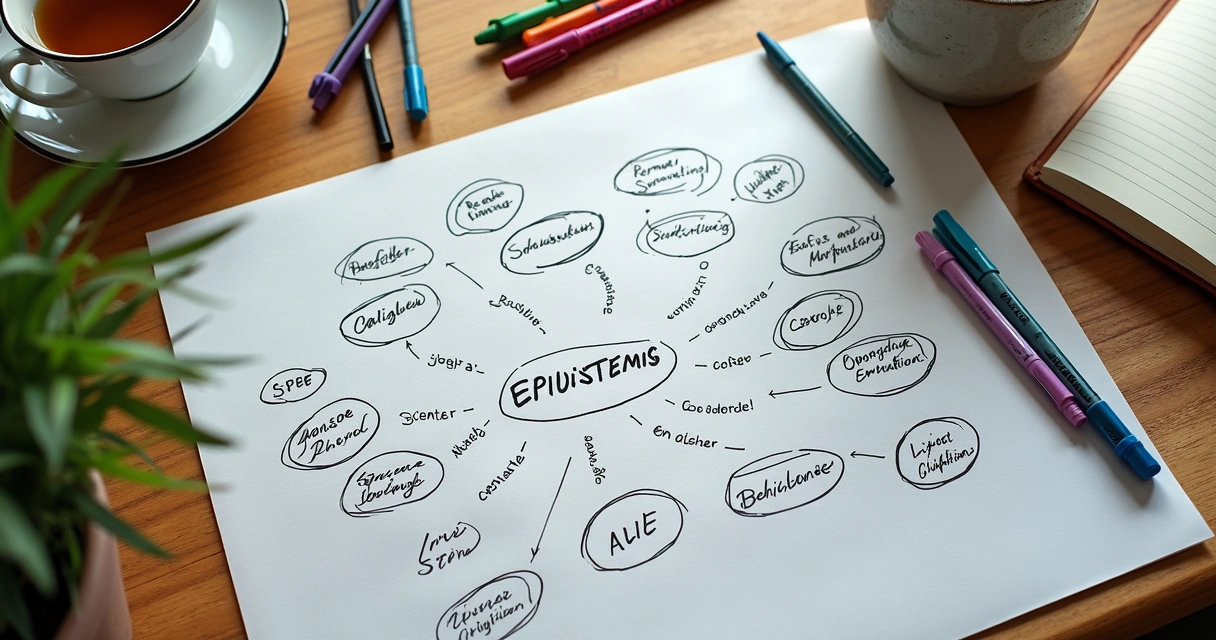
Setting out on your first epistemic map requires little more than curiosity and honesty. In our practice, we usually break it down into five steps.
- Choose your focus. Decide on an area you want to reflect on. It might be a decision, a repeating conflict, a feeling you can’t name, or a belief you’re unsure about.
- List existing knowledge and beliefs. What do you know, believe, or assume about this area? Write these as separate points.
- Add connections. Now, start drawing arrows or lines. Which beliefs support or contradict each other? Which emotions are linked with certain beliefs?
- Identify gaps or uncertainties. Where is your knowledge weak, or where do you feel uncertain? Mark these spots clearly.
- Reflect and update. Step back. What does the map show you? Do you spot patterns? Now, update the map as you notice new connections.
It can help to use colors or icons to mark emotion, logic, or intuition. We find that even a rough, hand-drawn diagram can make a difference.
Core elements to include
For the best impact, we think it’s useful to include several key pieces while creating your map:
- Beliefs: These are the ideas you accept about yourself, others, or the world. Write them as statements.
- Assumptions: Consider what you take for granted without proof. These might be harder to spot but can shape your choices strongly.
- Emotions: Name the feelings that arise around certain beliefs or experiences.
- Decisions or behaviors: Connect actions or habits to the beliefs and feelings driving them.
- Questions: Mark doubts or areas where your information is incomplete. These drive deeper reflection.
Adding feedback from experiences, mentors, or trusted friends can bring even more clarity to your mapping process.
Applying epistemic mapping in daily life
Mapping isn’t just a theoretical exercise. In our experience, we gain the most when we connect mapping with current personal challenges. For instance:
- Mapping our beliefs about a relationship highlights recurring themes or hidden fears.
- Tracing the assumptions behind a tough decision reveals if it’s reasoned by fact or guided by emotion.
- Connecting recent emotional reactions to core values shows how closely our daily life fits our inner standards.
Insight appears at the meeting point of thought and feeling.
We encourage checking back on your map after some days. Often, as new insights come, your understanding shifts, like seeing a slightly different color in the same painting.

Simple tips for richer outcomes
We have tested and collected a few simple approaches that can make epistemic mapping work better for self-reflection:
- Keep judgment aside at first. Focus on describing, not evaluating your beliefs or feelings.
- Check for clusters. Are some beliefs or emotions closely linked? Spotting clusters can reveal deeper driving themes.
- Mark your uncertainties. Confusion isn’t failure. Acknowledging what you don’t know is progress.
- Ask for perspectives. If comfortable, share your map approach with a neutral friend or mentor. A different view might reveal what you miss.
- Look for repetition. If a belief shows up in different areas, it may have a large influence.
These small changes can turn a confusing mental tangle into a practical map, encouraging step-by-step growth.
By visually mapping ideas, feelings, and questions, we create opportunities for better self-understanding and personal renewal.Conclusion
Epistemic mapping gives us a fresh, practical method for personal reflection in our complex world. By connecting our beliefs, feelings, and actions on a visual map, we see things about ourselves that were hidden before. We think that everyone can benefit from setting aside time for this kind of mapping, especially when facing decisions or searching for meaning.
With a simple start—choosing a focus and mapping connections—we begin to build bridges inside our minds. The process is gentle but powerful. It turns confusion into clarity and provides a reliable path forward. In every map, there is something new to discover.
Frequently asked questions
What is epistemic mapping?
Epistemic mapping is a process of creating a visual or conceptual map of your beliefs, knowledge, assumptions, emotions, and their connections so you can understand how your thinking develops and influences your decisions.
How can I start epistemic mapping?
We recommend starting by picking an area of your life you want to reflect on. List out your beliefs and feelings related to that area, then draw lines or arrows showing how these pieces connect or contradict. Mark where your knowledge is certain and where it is unclear. By examining this map, you can gain new perspectives and gradually update it as your understanding grows.
Is epistemic mapping useful for self-reflection?
Yes. From our experience, epistemic mapping offers direct benefits for self-reflection because it allows you to make your unseen beliefs visible, question assumptions, and clarify complex thoughts and feelings. This often leads to better self-understanding and improved choices.
What tools do I need for epistemic mapping?
Basic tools like paper and pen are enough to create an epistemic map, but you can also use digital drawing tools, whiteboards, sticky notes, or specialized mind-mapping applications if you prefer working digitally.
How often should I use epistemic mapping?
We suggest using epistemic mapping whenever you face complex questions, decisions, or ongoing confusion. Some people do it once a month as a regular practice, while others turn to mapping only when needed. The key is to update your maps when your perspective or circumstances change.