


We witness daily how teams succeed or struggle not just because of skills, but because of how people see, feel, and act together. Consciousness, in our view, is not a vague word. It means the awareness and integration of emotions, thoughts, and shared purpose within a group. When we map this terrain, we make the invisible visible, shining a light on patterns that shape every decision, conflict, and breakthrough.
Teams grow when they see themselves clearly, together.
Why team consciousness matters now
Every team is a living system. Years of research and our own experience confirm that teams with high awareness of their internal states adapt and respond better to uncertainty. According to a survey on team dynamics in primary care, conditions such as shared understanding and supportive processes are closely linked to how “team-like” members feel—and this, in turn, shapes their effectiveness.
Beyond skills and roles, the core difference between high-performing teams and the rest often lies in consciousness: a shared sense of intention, presence, and interconnection. Consciousness mapping gives this abstract quality a shape, so we can talk about it, assess it, and help it grow.
The foundations of consciousness mapping
Mapping consciousness within teams is not just about charting personalities or listing competencies. It involves observing and understanding several intertwined dimensions:
- Emotional climate—What feelings are present, spoken and unspoken?
- Attention and presence—How do members focus during discussions or challenges?
- Shared purpose—Is there alignment on “why” the team exists and what it seeks?
- Behavioral patterns—Which behaviors are encouraged, and which are suppressed?
- Roleing and involvement—How do people move between taking charge and supporting others?
These aspects blend into a dynamic field—a map is alive, not static. We have found that discussing this openly helps people connect their personal motives to the team’s collective goals.
How to start mapping team consciousness
We usually recommend a gentle, structured approach to mapping. Jumping into deep questions too soon can backfire; trust and psychological safety come first.
- Set the stage.
Clarify that this is not an evaluation of individuals, but a tool for collective growth. Use language that normalizes vulnerability and honors confidentiality.
- Choose the right moments.
Try to introduce consciousness mapping during transitions: after major changes, new project phases, or when conflict lingers. These moments make teams more open to reflection.
- Ask open questions.
Use prompts like:
- “What are we noticing in our energy right now?”
- “Where do we feel most aligned, and where not?”
- “What patterns keep showing up in our meetings?”
- Visualize together.
Draw simple diagrams or maps to chart emotional intensity, perceived alignment, or recurring issues. The act of drawing together often uncovers insights that words alone cannot reach.
- Reflect and act.
Welcome all perspectives, then pick a few concrete steps to experiment with. The goal is to shift from passive observation to co-creation.
In our sessions, we see how a well-timed question can change the atmosphere from tense to curious, or from stuck to creative. This collective openness is the heart of mapping consciousness for growth.

Scientific insights: What happens in the group mind?
Recent studies in neuroscience are changing how we understand team performance. For example, research reported in Social Cognitive and Affective Neuroscience revealed that synchronization at the neural level—literally, our brains “tuning in” to one another, predicts collective achievement. When team members’ brain activity aligns during tasks, their results improve significantly.
This matches what we see in team mapping: successful groups often reach a flow state, where everyone feels present, ideas circulate freely, and the whole becomes more than the sum of its parts. At moments like these, the contours of the map shift—the team feels different, more alive, more creative.
Measuring growth over time
We always recommend looking at consciousness not as a one-time picture, but as an ongoing process. A review in Frontiers in Psychology points to the need for longitudinal assessment. Teams grow, leaders shift, and new challenges arise. Mapping should reflect this evolution.
Some reliable ways we have tested for tracking progress include:
- Short, recurring group surveys asking about clarity of purpose and emotional tone
- Regular reflection meetings, with space for surprises and learning
- Revisiting and redrawing the collective map every few months as the team’s needs shift
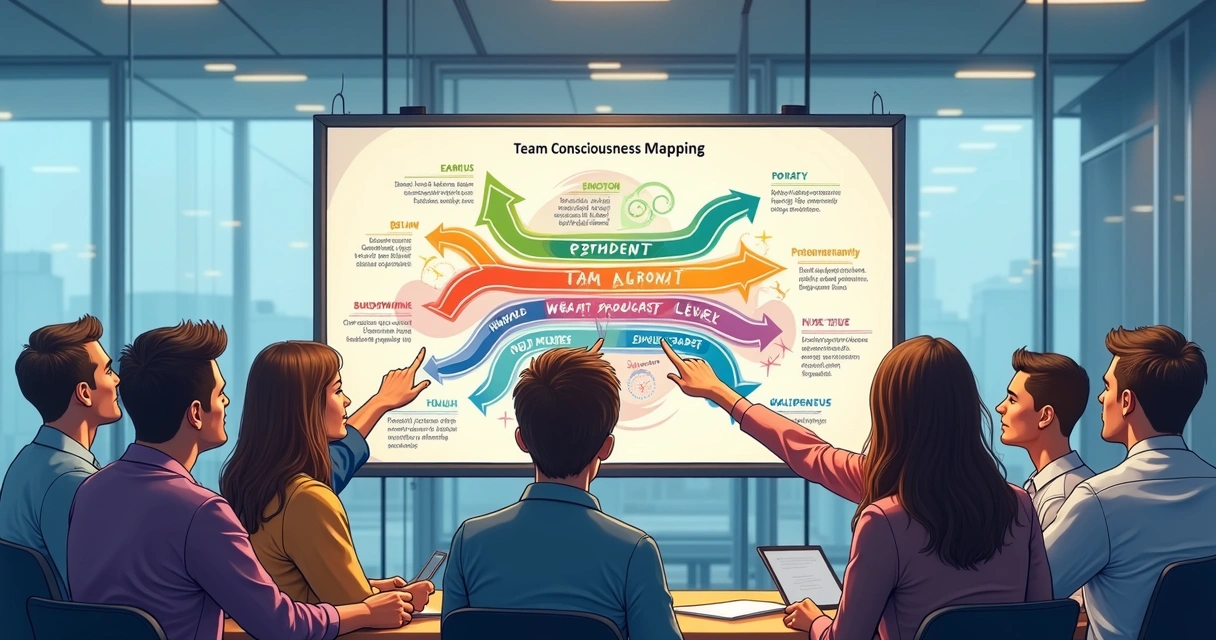
By treating consciousness mapping as a journey, teams give themselves space to grow and react to new realities. Growth is not always linear—sometimes the path loops, stalls, or jumps ahead after an insight. That’s expected, and honest mapping makes these shifts visible.
What to watch for: Common challenges
No method comes without obstacles. From what we have seen, a few patterns occur:
- Initial skepticism—Some team members may see mapping as “soft” or too abstract. Linking it to real challenges helps bridge this gap.
- Unspoken conflict—Mapping may reveal deeper tensions. Here, skillful guidance and respect for privacy matter.
- Action freeze—Teams may enjoy the reflection stage but fail to act. Setting small, shared experiments keeps momentum going.
Each team brings unique attitudes and experiences, so adapting the mapping approach is key. The intention is not to judge but to support conscious development as a group.
When we change the map, we change the journey.
The ripple effects of mapping consciousness
In our work, we have seen how small shifts in awareness transform teams. Increased openness leads to more creative dialogue. Better understanding of shared purpose leads to faster decision-making. People report feeling less isolated, more engaged, and able to handle complexity together. These outcomes echo what large-scale studies find about shared understanding and team effectiveness (Health Services Research).
The effects of consciousness mapping extend far beyond team meetings—they impact how people relate, solve problems, and find meaning in their shared work.
Conclusion
Consciousness mapping is a living practice, rooted in the everyday experiences of teams. By bringing attention to what is often hidden—emotions, beliefs, and collective patterns—we give teams new tools to support growth. The real benefit comes not from the map itself, but what happens when the team uses it: deeper connection, greater resilience, and an openness to learning together. As the world grows more complex, this kind of inner clarity may be what shapes truly adaptive, fulfilled teams.
Frequently asked questions
What is consciousness mapping for teams?
Consciousness mapping for teams is a structured approach to make visible the patterns of thought, emotion, and purpose within a group, helping members understand how they connect and function together. It uses reflection, dialogue, and visualization to reveal underlying dynamics that shape behavior and results.
How can consciousness mapping help teams?
It helps teams recognize hidden strengths, surface unspoken challenges, and build stronger alignment around shared goals. By improving mutual awareness, teams grow more adaptable and confident in handling both conflict and change.
What are the steps to map consciousness?
The main steps include:
- Creating trust and safety for honest dialogue
- Using open questions to reveal patterns and emotions
- Visualizing these insights together
- Agreeing on small actions to promote learning and growth
- Reviewing and updating the map over time
Is consciousness mapping worth it for teams?
Yes, teams that map their consciousness consistently report improved trust, clarity, and effectiveness, based on evidence from psychological and organizational studies. The process is most valuable when tailored to each team’s unique context and embraced as ongoing development.
Where to learn more about consciousness mapping?
For further reading, consider scientific articles on team dynamics and neuroscience, such as studies published in Health Services Research and Social Cognitive and Affective Neuroscience. Peer-reviewed journals and organizational psychology books often provide case studies and step-by-step guides to team development through reflective and systemic methods.